
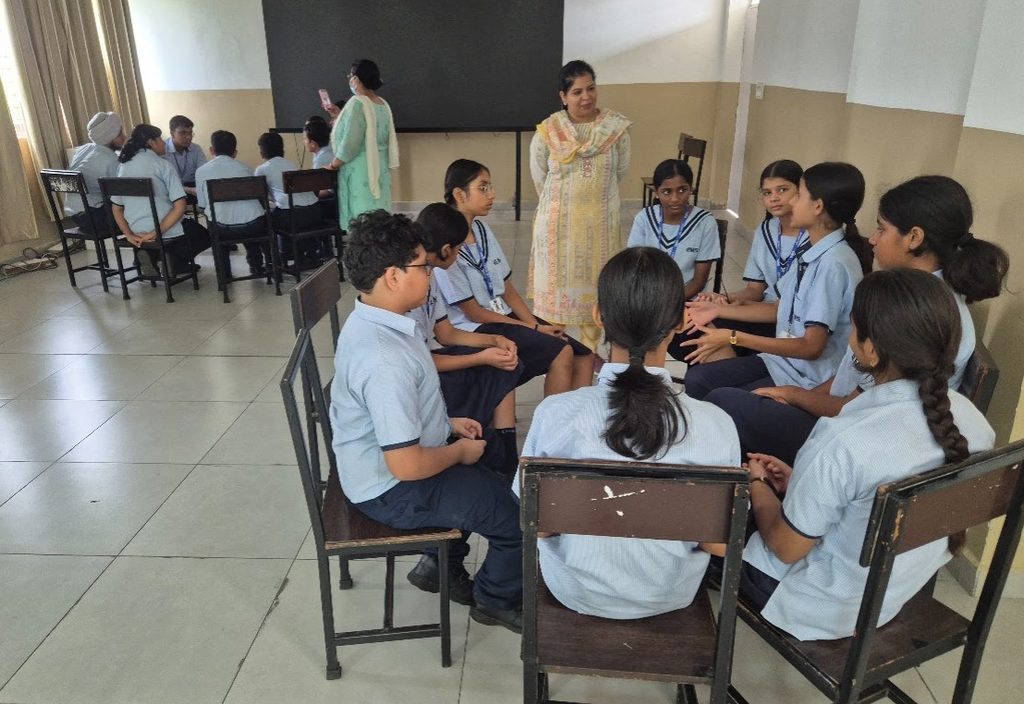
As before, CMS have asked me to take a series of drama workshops in various of the campuses during the time I am here, and I have just come to the end of the first of those, at Kanpur Road, one of the oldest, and largest, of their sites. I had messaged the teacher in charge in each case, to see if they had any particular areas or ideas they wanted me to cover, as well as offering a general introduction. I was very pleased when Mamata ma’am asked if there could be some work on characterisation, particularly as it applied to characters in books. This encourages me to move away from my standard, mime-based intro, and explore new ideas, something of a blessed relief to move away from the same old same old.
Over the three days, and after some mime work – it is a useful way in – we explored different approaches to characterisation, first creating something new out of their own imagination, using various starting points. On the final day, however, we really did step into new territory. I had been asked to look at character within a play, how it might develop, and this allowed me, for the first time in many years, to teach the ideas of Stanislavski. There was no time for an in-depth discussion, but I did emphasise how important he was in changing the way we view the craft of acting, and we explored three of his concepts.
The first was the general idea of truthfulness, that the action on stage should have its basis in real life. I asked students to enter the classroom, using the real actual door, but treating it as though coming home… where they would find either a letter of a phone with a message on it. There was only time for five students to demonstrate this exercise, but all were superb, bringing imagination and commitment. We did discuss how mobile phones were difficult to use in modern plays, not just because they make the plots of many plays absurd or illogical, but also because the act of sending a message lacked dramatic power, merely consisting of someone using their thumbs. Perhaps because of this, four of the five cjose to use a real letter.
The second exercise used the idea of the Given Circumstances, the idea that the actor should know his/her character. We used the interview, with each student choosing a character from a book or play that they knew well, and being asked questions which they would have to answer in role. Two students demonstrated this to the class, before we broke into four separate groups, and both were astonishingly sophisticated, with young Indian students giving knowledgeable and intelligent answers, as Elizabeth Bennet and Lemuel Gulliver respectively.
Finally, we used the notion of Emotional Memory to inform the delivery of a particular line: But Caesar said he was ambitious, and Caesar is an honourable man, all infused with anger, dragged out from their own experience. And then a line, and emotion, of their own choosing. It had been an excellent conclusion to what had otherwise been workshops which had slightly disappointed me. Done them too many times, I guess.