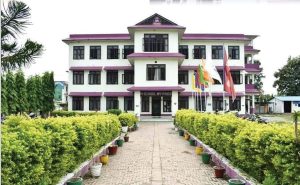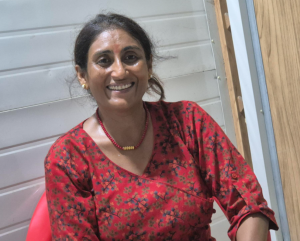
Just to clarify (I might have mentioned this before, but, well, there you go) Aparna’s job at SPA, International Relations Officer, extra-curricular co-ordinator, social media co-ordinator) is just her part-time job. Her real, full-time job is as a teacher at a rural school. And today I was going there for a visit. Which meant, of course, another trip on a motor-bike (my third, if you’re counting.)
Today, there was an additional complication, which is that it was raining. Luckily, it had calmed down since the tremendous thunderstorm last night, when enormous claps of thunder had seemed to shake the building, but the rain was still coming down pretty hard (and seemed to get harder as the journey went on.) I was dressed in my red waterproof, getting maybe its second airing since I had arrived; my driver, Trilok, an English teacher at the school (and also owner of the restaurant where I get my momos), had only a t-shirt.
The first part of the journey, weaving our way through what passes for suburbia and out to the main road, was by now pretty familiar. (I had thought when I arrived that Dhangadhi was quite a sizeable city, and so there had to be a whole section of it that I had never seen, but in fact it is pretty simple, and I think I know most of it.) But then we turned off the main road, out through some country lanes.
There were the usual delights – swerving round a cow that suddenly decided to wander across the road, water buffaloes by the side of the road, a small village or two. At first, the road, while winding, was well-paved, but then we came to the unmade section, with rocks and, after the rain, lots of mud. Slippery mud. “Now it starts,” said Trilok. “Don’t be frightened.” “I won’t,” I replied (and I wasn’t.) “I trust you. Just don’t kill me.”
The ride was slow and bumpy, but it was still a road. Until it seemed to disappear, the only possible route a narrow concrete path, with high walls on either side, which veered up and away t our left. Surely it couldn’t be… But it was.

I wish I had captured that ride across on video, though I did try, pulling my phone out of my pocket and hastily switching it on, while we rode across. Or, as I now realise, switching it off – I did have some footage of the inside of my pocket. But I could not stop laughing. Not hysterical laughter, just wild appreciation of the absurdity of it all, and sheer amazement that it was happening at all, and that I was experiencing it.
The tricky bit was getting past other people on the bridge – children with umbrellas, women with shopping – for it was very narrow; you would scarcely have thought there was room for a bike. And then we met, half-way across, another motor-bike coming the other way. That did require both of us to stop, and somehow both squeeze past (the biggest problem was getting the grips at the end of the handle-bars under and over each other.
But then it was done, we were over. We would have to come back the same way, of course ( and it is that trip that is shown above, when I was better prepared, camera ready.) And during which I was no longer laughing wildly; it is remarkable how quickly such a thing becomes normalised (though it isn’t normal, not at all.) But it is the daily commute for Trilok, for Aparna (who gets a lift with the deputy head) for others too. Day after day, week after week, year after year. The lives of the villagers out here was very poor before the bridge had been built, Trilok told me – it was a lifeline.