
Another visitation in the morning, but this time a more welcome one, Mr Forones knocking on our door at some unearthly hour to tell us that the driver was ready to take us to Camp Layun. So, as is so often the case, there was a panic to get everything ready (tho’ there was time, luckily, to down a quick couple of coffees.) We rode in the front of the Land Cruiser, so had the most comfortable of rides, tho’ there were a couple of people hanging on in the back – at least they made us feel the trip wasn’t being laid on exclusively for our benefit. Our driver was very competent at coping with the heavy mud on the road, tho’ he did manage to scare us a couple of times by racing down steep hills to give him some speed to climb the even steeper one ahead. He knew what he was doing, I’m sure, but with a steep drop on one side, we didn’t want him to make any little mistakes. We were climbing up into the hills, and the scenery around was spectacular –green forests, blue mountains.
The trip took about 45 mins, + we were at Layun, an even bigger place than the base camp back at Bedian. We reported to Mr Lu, the production manager, who turned out to be extraordinarily nice – friendly, helpful + interested, without being intrusive. He pressed upon us more coffee, + opened up a pack of chocolate biscuits, + when he’d arranged a driver for us to take us to the Punan village, Long Lang, just 3 or 4 kms away, he pressed the rest of these goodies upon us. Our companion for the journey to the village was the young surveyor we’d travelled up to Long Bedian with. He was going to Long Lang to recruit some workers for a new camp.
The Land Cruiser wasn’t able to take us all the way to the village, but dropped us at the top if a steep road a few hundred metres before it, + we walked. This was a more satisfying way of arriving in any case – we were able to appraise the village slowly, + not simply be dumped in the middle of everything + everybody. The village was clearly not wealthy – in comparison with the laid-out order of the other places we’ve been, it was a ramshackle collection of huts, scattered around a large building, a church, in the middle. They were all raised up off the ground on stilts, + the majority were interconnected with raised walkways. The Headman wasn’t present, but once we had been welcomed, + were sat in the assembly area, there was soon a curious crowd grouped around us. It ws fortunate that our friend was with us. He spoke some Punan, + so was able to explain that we wanted to stay. He also reassured them that we were happy to try sago, + had no objection to pig. But he soon left, + then we were on our own. Almost as if to test us, we were brought a bowl of sago. We now realised that, in fact, we had tried it before – at Long Bemang we had been given a bowl of the stuff, the only food we’d been given that we couldn’t cope with at all, mainly because of the texture – it has the consistency of phlegm. This was better, being at least edible, but I couldn’t pretend I enjoyed it. To me, it tasted like lard, having the same savoury greasiness, leaving the same filmy deposit in the mouth.
Having done our duty by the sago, we asked for a tour of the village, + tho’ this wasn’t really what we got – we were taken for a short stroll around the desolate area in front of the village that had been levelled by the timber company, it was good to stretch the legs. Communication was obviously not going to be easy – only a couple of the people spoke Bahasa. So we didn’t spend much of the day chatting. In fact, we were generally left alone. Various people would come + watch us for a time – we were doing some craft-work – but then they’d get on with their own business – tending to the babies (a funny thing – there were 6 or 7 kids under 4 about, and they were all boys. Must be something in the water… or a curious sort of sexual apartheid that I haven’t heard of.) Val was learning how to plait the basket-work the Punans make – apart from the young men going off to work for a time with the timber companies, it’s just about their only form of cash income, but then their needs are small – basically just sugar + salt, plus a tiny amount of oil to fuel their tiny lamps. They run no motors or engines, so do not have to concern themselves with parts or fuel.
For my part, I buried myself in macramé-ing a bracelet, which attracted the attention of various people. After some persuading, one of the young guys tried his hand at it, + picked it up pretty fast, so I cut him some strings + he did his own. And so we passed the day. Which is probably as good a way as any of observing the way the people live. If you try too hard, like as not they’ll either clam up or you’ll alter what it is you’re trying to see.
Sometime during the afternoon, the headman re-appeared, + quite an impressive entrance it was too. He was short but powerfully built, + in his 30s I should say. Strapped to his back was a home-made bag containing his catch, a wok cooking-pot, a spear, a blow-pipe, + a bamboo “quiver” – we’d been shown another similar one earlier in the day, + it was full of blow-pipe darts, about 100 of them. Each one was hand-carved, + each one different, so far as I could see as individually tailored as a fisherman’s flies. And tied to the top of all of this was a baby monkey – a pet one, alive. Maybe he had killed the mother. This would have made the perfect ethnic photo, the Return of the Native, or somesuch – except that he was wearing a pair of Adidas shorts. (Nothing else, mind you.) He did not seem to be at all fazed by our presence, but quietly got on with divesting himself of his burdens, + greeting his wife + baby son.
Just a word – I would say that the children are over-indulged, in that they are not denied anything, + are a constant focus of attention. The thing that prevents them being spoilt is that there are not enough things for them to be spoilt on.
A short time after, we were able to taste the result of the headman’s efforts, when the meat he had brought back was cooked. I think I saw a couple of claws hanging around so I imagine it was some kind of bird. Definitely not tender, melt-in-the-mouth meat however. To accompany it, the Punans had a vast wok of sago, but guessing correctly that we wouldn’t be able to take more than a polite mouthful or 2 of this, there was also provided, for us alone, a plate of rice + a plate of green vegetables. We certainly weren’t going to starve. We were most taken with their home-made eating implements, a wooden four-pronged fork, the prongs forming a square. One could spear pieces of meat with it, tho’ its particular forte was in being used to twirl the sago into a ball – the stuff id so glutinous (like phlegm, as I commented before) that it’s the only way to separate a mouthful-sized piece from the rest. I suppose the forks would also be good for spaghetti, tho’ I can’t imagine the Punans taking to it.
We took the opportunity of giving some presents – a couple of tins of food, a couple of containers of sugar. The atmosphere in the hut mellowed as the light faded – the oil lamps were lit – hot sugared water was brought out, and we thought it was quite sweet when a pet tortoise was brought out. Obviously the creature had a clearer idea of its fate than we had, + was struggling desperately to get away, tho’ luckily I too realised what was about to happen just before it did, + averted my eyes. At any rate, the poor creature was killed. A tortoise would be difficult to kill, you might think, due to its ability to withdraw its head, but I think the method used was to thwack the shell until it softened up, then take the whole thing + squeeze the creature’s head out. Then smash it. Quickly. But, as I’ve said before, if one eats meat…
We were provided with a piece of lino for a bed, + crawled off there.
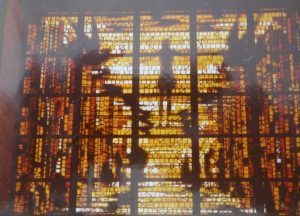
No photos, regrettably, because of the camera issue, and this was a shame, for this really was a most extraordinary encounter, unlikely to last too long, regrettably, with their habitat being cut down around them, so it would have been good to have some visual record. But things are what they are (or were) so you will have to make do with my words. The p[icture that does illustrate this post is of the church at Long Bedian, not the far more ramshackle one we found at Long Layan.
But they were hospitable people, all the more so when they had so little to share, and it was a memorablr experience.