
The thing that I started with when thinking of how to stage Aesop this time around was the set. It is the play of mine that has gone through the greatest variety of productions, the most different directors… though me mostly, of course. It began with a completely open outdoor staging, using the natural amphitheatre created by the horseshoe-shaped mound at Lord Williams’s Lower School, and then has had various stagings. Here in Lucknow, the staging had to overcome a number of challenges. The production could not happen outdoors: too hot, too much chance of rain. And the indoor auditoria at CMS are enormous, far too large for the very human activity of theatre, unless everyone is miked, and there are video cameras and screens to make (some of) the action visible.
But out of adversity springs creativity. I had decided to opt for a circular stage area, half on the stage proper, with a large semi-circular curtain running around the rear, and half in the form of a forestage. Luckily, both auditoria (of which more later) had steps running all the way across the front of the stage, which I could also incorporate into the acting area. The audience would be wrapped around
This was the concept – a sort of modern version of a Greek theatre, though without the raked seating which would give everyone a good view. I was determined that we would not use microphones. Apart from the practical considerations – the fact that they go wrong so often, that they distort the voice, that forty actors mean forty mikes, with each one needing to be controlled individually – there was a more philosophical aspect, harder to explain. Theatre is storytelling, and this is a human activity, probably the oldest art form. In my belief, it needs to be human-scale, its limit defined by the distance a voice can carry. The Greeks did not use microphones (though to be fair, their masks did have a device for amplifying sound.) Shakespeare certainly did not use amplified sound. And though microphones have their place, especially in musical theatre, where the human voice has to combine and compete with an orchestra, in straight plays I would always try to avoid using them.
This decision would have consequences. It would mean artificially limiting the size of the audience; there would be no point in filling the auditorium if the audience could neither see nor hear. Even more importantly, it would mean getting the actors to use their voices to their full capacity, to face the front as much as possible, and to project. This is a mighty challenge, and even now, on the eve of performance week, it is the aspect that is causing me the greatest concern.
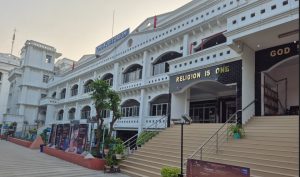
But initially, the first hurdle was working out the practicalities of the concept. It would need what is called in the theatre a cyclorama, a large curtain, onto which light could be projected. At our large production meeting, involving Saba, Mohit (my lighting designer/operator), and the technical managers from both sites. Both sites because CMS have decided that the production should have two performances in one campus (Gomti Nagar 1) and then, after a day spent dismantling set, lights, everything, moving across town for two more performances at Rajajipuram !. A lot more effort, of course, but undeniably exciting. At the meeting, their first reaction was that what I was asking for was impossible. But when Mohit and I e3xplained it carefully, it was agreed that it could be done. The major issue was the cyclorama, but even then I was told that yes, it could be managed. But did it have to be so high? This would make it very expensive. Not wanting to spend other people’s money, I agreed to reduce the height. And then did it have to be a curtain? Wouldn’t a semi-circular wooden screen do the job? And once more I agreed; if they felt that was more manageable, I really did not mind.
These discussions were some weeks ago. Only yesterday did it suddenly appear. And was well-made, not bodged. What was more, they had built a semi-circular wooden forestage, something I had not asked for, but quite perfect. Compromise on one hand; a totally professional and unlooked-for construction on the other.
The set is relatively plain, its only real feature being a tree. I asked for a real tree, not realising the fuss it would cause. I have seen plenty of dead trees lying around Lucknow; there is a constant pruning and removing regime, and so thought this was the obvious solution. But no; this would mean asking for permission from the Forestry department.
When it looked as though they were at first going to simply ignore my request for a tree, and then told me my request was impossible, I tired of the whole struggle, told them to bring one of the cardboard cut-outs they had in storage. At which point, once again they swung to the opposite extreme. They got one of the gardeners to chop down an actual tree, and sent me a picture. Would this do? Of course it wouldn’t; it was far too thick. So they chopped down a smaller one, and brought it over. Still far too big, and with most of its leaves and branches removed, but once it was put into position, and its top tied to the lighting grid, it served its purpose.
And, actually, looked pretty good.