
After a somewhat contrived breakfast – omelette and coffee was understood, juice made understandable, anything else beyond them – we spent the morning reading, writing; we could not get to Yogi’s too early, as he was still involved in some sort of strict religious observance, which had lasted for the past thirteen days.
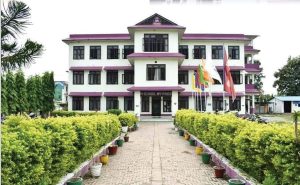
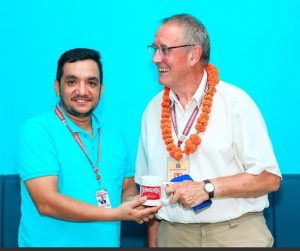
But when it came to leaving, the hotel pulled out all the stops, first providing some special festival roti (formed into a ring and deep fried, I believe) which was very nice, to accompany a small bowl of vegetables, and then a farewell ceremony, in which we were given a tika and a special ceremonial scarf each (I have encountered such things before, but this was silk, or silken, so rather more fancy.) And then we were to be conveyed in their own jeep, first for some sight-seeing, and then to Yogi’s. We would be paying for this, but it made all the arrangements so much easier.
The first stop was at the temple we are calling the tunnel temple, just a short ride from Baglung. It was relatively small, but was clearly in the process of being further developed, as they were building a small additional temple there – we would call it a chapel. But the site was dominated by a hue statue of a roaring tiger head. At this point we were intercepted by a priest, Swami Govinder, who invited us inside, into the mouth of the tiger, where we paid a small fee, before being shown behind a curtain at the back of the tiger’s mouth.

There we were confronted with a huge long artificial cave, actually a tunnel, extending into the mountain for some thirty metres or so. Along the middle of a tunnel was a model of Nepal, of the sort that is more often used at home to accompany a model railway layout. Only this was by no means to scale (all the more so since it also contained models of animals etc. It was a little on the crude side, but was nonetheless impressive, showing mountains, rivers, bridges etc. So far as Govinder was able to tell us – his English was rather stumbling – it represented the holy rivers of Nepal, and various sites there, Pokhara in particular. He did make an attempt to record a short video interview with us, but I think that petered out rather quickly.
At the end of the tunnel was a shrine, and we were told we could take a picture or two, because he had given us permission, despite the sign banning same. There were a couple of shorter side tunnels at the end, and these were mainly used to display a large collection of black stones, all natural, we were assured, as well as some black fossils. We were questioned as to our vegetarianism or otherwise, and given a short lecture as to how we might achieve… I don’t know, enlightenment or something, or at least give us the ability to visit the temple a few yards further up, otherwise denied to us. There did seem to be almost a feeling or recruitment (when I had thought Hinduism was a non-proseltysing religion) but we managed to resist.
The next stop was Panchikot, a more significant and well known temple, which involved an almighty climb (fortunately, in the jeep, not on foot.) It was more geared up for tourism, with a number of stalls, but was also hugely impressive, from a design point of view, with some huge, colourful statues, perhaps the most impressive that of Shiva riding an eagle. Again, there was evidence of large building projects, and the statues seemed newly painted, so it is clearly a still living, vibrant religion (as opposed to Christianity, which seems locked into the past.)

We stayed long enough to take some photos, and then were back in the jeep to resume our journey; we were concerned about arriving at Yogi’s in good time (as well as allowing our driver time to return.) It was a far more challenging drive than I had imagined, for the road was soon very much in a state of under construction, and for much of the next two hours we were buffeted around violently. It did pass by a few scattered settlements, nut it must have been pretty hellish living there recently, for any vehicles travelling through threw up huge clouds of dust.
On a couple of occasions, we encountered small groups of children who slung a rope across the road to stop a vehicle, and then engaged in some dancing and drumming. I thought it was quite charming, but our driver had no time for such light-hearted highway robbery, and on both occasions they were dismissed.
Eventually we arrived at our destination, to be met by a small group of people at the side of the road… including Yogi and his brother Bhumi. Our bags were unloaded, Val paid our driver, and we were conducted to Yogi’s family home. We had been cautioned it would be pretty basic, and so it proved, rather more so than we had anticipated, with no furniture, and a small fire in the middle of the bare floor.
We were given tea, and spent a little time sitting on the bench outside, chatting with Bhumi. But soon enough we were drawn by the sound of music to a divali celebration a few yards down the street, and then went down to take a look. We were welcomed there and given seats of honour on one of the terraces directly in front of the small event; it is a relatively narrow street, so was no bigger than the width.
We were all told that the event had been delayed for ten minutes by a technical issue: which turned out to be that the buffalo in the barm immediately behind the event was being milked, and the loud noise of drumming would immediately cause it to stop!
But then, when the drumming began, it was terrific. Just three or four drummers, a couple of singers – one man, one woman, plus a small harmony group, with the drummers dancing as well, along with one woman. There was as big a crowd as the tight venue would allow, but most, like us, were merely watching (and recording the event on their phones.)

After a few songs, it became clear we would be welcomed to participate, and so we joined the dancers, to great excitement; it was good that we felt ourselves to be a welcome addition to the event, rather than an intrusion. And then, when we could, we slipped away; we knew that dinner would soon be awaiting us (and, since none of Yogi’s family had attended the event apart from Jibyata, their young daughter, we were not sure our absence had been entirely welcomed (though Yogi did appear, to take some video, and assure us we should enjoy ourselves.)
Dinner was fine, though served to us alone in the living-room (a pattern observed throughout our stay.) And then we were told we would be sleeping in the house next door, where a room had been vacated for us. It had a wooden bed, some blankets, some electricity, and so suited us very well.